You’ve just mopped the kitchen floor. You stood back, admired it for approximately four minutes, and then walked across it to put the mop away – and now there are footprints. By the time anyone else in the household has passed through, it looks like you never mopped at all. If this scenario is frustratingly familiar, the problem almost certainly isn’t your effort, your mop, or your floor. It’s your cleaning solution – or more specifically, the residue it’s leaving behind. A sticky kitchen floor is not a dirty kitchen floor in the traditional sense. It’s a floor with a residue problem, and mopping it with the wrong product doesn’t clean it. It layers the problem deeper. This article explains exactly what’s causing the stickiness, how to break the cycle properly, and how to keep it from coming back – because mopping a floor twice a week and still feeling like it’s never clean is a problem worth solving once and for all.
Why Kitchen Floors Get Sticky in the First Place
It’s Not Just Grease – It’s Chemistry
The kitchen is the one room in the house where floors face a genuinely hostile environment. Cooking produces airborne grease particles that settle on every horizontal surface, including the floor. Everyday foot traffic grinds those particles in. Drinks get spilled, food drops, and the general business of cooking means the floor accumulates a complex mixture of oils, sugars, starches, and proteins on a daily basis.
Each of those residue types behaves differently, which is part of what makes kitchen floors so persistently difficult. Sugars and starches – from juice, soda, pasta water, and sauces – dry into a thin, tacky film that is almost invisible but incredibly effective at grabbing dust and foot traffic. Cooking oils polymerize with heat and repeated exposure, bonding to the floor surface in much the same way they bond to oven racks. The result is a floor that feels clean to the eye but sticky underfoot, and that attracts new dirt within minutes of mopping because the surface itself has become adhesive.
Add the soap residue left behind by most commercial floor cleaners – which, in hard water areas, combines with minerals to form a dull, slightly sticky film of its own – and you have a floor that is essentially being re-dirtied by the product meant to clean it.
The Residue Problem Nobody Talks About
Why Your Cleaning Product Might Be the Culprit
This is the part that surprises most people: the single most common cause of a persistently sticky kitchen floor is using too much floor cleaner. It seems counterintuitive – more product should mean cleaner floor – but the logic breaks down in practice.
Most floor cleaning products are soap-based or detergent-based, which means they need to be thoroughly rinsed away to leave a clean surface behind. In normal household mopping, there is no rinse step. You apply the solution, mop it around, and let it dry. What dries on the floor is not just lifted dirt – it’s also a thin layer of soap, which is inherently tacky and attracts airborne particles and foot traffic debris immediately.
The problem compounds every time you mop. Each session adds a new layer of diluted cleaner over the residue from the last one. Over weeks and months, this builds into a dull, sticky film that no amount of regular mopping removes – because regular mopping is what created it.
In Chula Vista, where hard tap water is a genuine consideration, soap residue and mineral deposits combine into a film that is particularly stubborn. If your floor looks hazy or dull in addition to feeling tacky, that’s almost certainly what you’re looking at.
Step One – The Reset Mop
Stripping the Residue Before You Change Anything Else
Before any new cleaning routine will work properly, the existing residue buildup needs to come off the floor entirely. Think of this as a reset – one deliberate, thorough clean that gives you an actual clean surface to maintain going forward.
Fill a bucket with hot water and add half a cup of white vinegar per gallon. No additional cleaner. Vinegar is mildly acidic, which makes it effective at cutting through both soap residue and the thin, polymerized grease layer that most kitchen floors carry. It’s also completely residue-free when it dries – there’s nothing in it that contributes to stickiness.
Mop the entire floor with the vinegar solution, working in sections and wringing the mop thoroughly between passes so you’re applying a damp mop rather than a wet one. Then go over the entire floor a second time with clean hot water only. This two-pass approach – vinegar solution followed by a plain water rinse – is what most standard mopping skips, and it’s what actually lifts residue off the surface rather than redistributing it.
For areas with visible stickiness or grease buildup – in front of the stove, near the sink, around the kitchen island – apply the vinegar solution directly and let it sit for three to five minutes before mopping. This dwell time matters. Giving the acidity a moment to work before you physically move it is the difference between loosening that polymerized layer and just pushing it around.
Step Two – The Right Ongoing Cleaning Solution
Less Product, Better Results
Once the floor is genuinely clean – not just mopped, but free of residue buildup – maintaining it becomes significantly easier, provided you change the product and the dilution ratio.
For regular maintenance mopping, the most effective approach is also the simplest: two to three drops of dish soap in a full bucket of hot water. That is not a typo. Two to three drops. At that concentration, you get the surfactant action that lifts grease and food residue without leaving enough soap behind to create a new sticky film when it dries. The water should feel slightly slippery, not sudsy – if you’re seeing bubbles, you’ve used too much.
Alternatively, the vinegar-and-water solution from the reset step works perfectly well as a routine cleaner for most hard floor types – tile, luxury vinyl plank, laminate, and sealed hardwood all tolerate it without issue. The exceptions are natural stone floors like travertine or marble, where the acidity can etch the surface over time. If you have natural stone, diluted dish soap at the concentration above is the safer ongoing choice.
The product you should largely stop reaching for is the pre-mixed floor cleaner you pour directly into the mop bucket. Most of them are concentrated enough that even a “diluted” dose leaves residue. If you prefer a commercial product, look for ones specifically labeled “no-rinse” or “residue-free” – they exist and they work, but they’re not the default formulation of most popular brands.
The Mopping Technique That Actually Matters
How You Mop Is as Important as What You Use
Even the right cleaning solution underperforms with the wrong technique, and the most common mopping mistakes are simple to fix once you’re aware of them.
The first is mop saturation. A soaking wet mop pushes water and dissolved dirt around the floor rather than lifting it. Wring thoroughly – the mop head should be damp, not dripping. A damp mop picks up residue. A wet mop redistributes it.
The second is working in the wrong direction. Mop from the far end of the room toward the exit, working in overlapping passes so you’re always moving clean solution forward rather than tracking back over areas you’ve already covered. It sounds obvious until you watch most people mop, at which point it becomes clear that most people don’t do it.
The third is bucket water. Mop water gets dirty quickly, particularly in a kitchen. If your bucket water is visibly gray or murky before you’ve finished the floor, change it. Mopping with dirty water deposits a fine layer of suspended grime back onto the surface, which dries dull and – depending on what’s in it – sticky.
For high-traffic areas in front of the stove and sink, a targeted pre-treatment makes routine mopping significantly more effective. A spray of diluted dish soap solution directly on the area, given two minutes to dwell before mopping, handles fresh grease considerably better than a single mop pass with no dwell time.
Floor Type Matters More Than You Think
Adjusting Your Approach to the Surface
Not all kitchen floors respond the same way to the same products, and using the right solution for the wrong floor type can create new problems while solving the old ones.
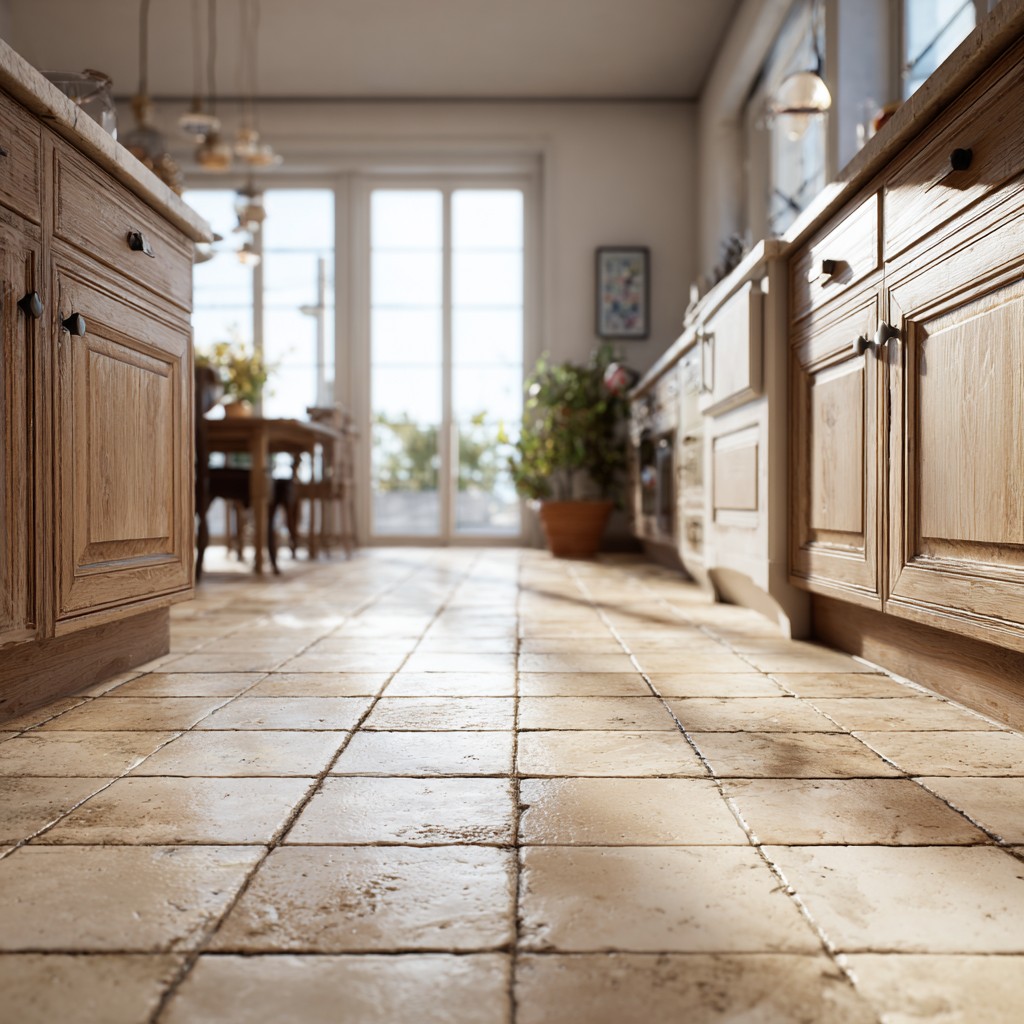
Ceramic and porcelain tile are the most forgiving – they handle vinegar solutions, diluted dish soap, and even occasional stronger degreasers without damage. The grout lines, however, are a separate issue. Grout is porous, absorbs grease over time, and is a major contributor to that persistently dirty look. A grout-specific cleaner applied with a stiff brush every few months – separate from your regular mopping routine – addresses what mopping alone cannot reach.
Luxury vinyl plank and laminate floors need gentler treatment. Excessive water is their primary enemy, as moisture can work into the seams and cause the boards to lift or warp over time. A well-wrung mop and a quick-dry solution matter more on these surfaces than on tile. The diluted dish soap approach works well here precisely because it requires so little product that the floor dries fast.
Sealed hardwood tolerates damp mopping but nothing more. If your hardwood floor feels sticky, the cause is almost always soap residue or a floor polish that has built up unevenly, and the reset mop with a highly diluted vinegar solution – barely acidic, barely damp – is the most appropriate first step before considering any refinishing or recoating.
Keeping It Clean Between Mops
The Habits That Make Mopping Less Frequent
A sticky kitchen floor almost always has a dry-dirt layer sitting on top of the residue, and mopping that layer instead of sweeping or vacuuming it first is one of the most reliable ways to make a floor look worse after cleaning than before. Sweep or vacuum before every mop – every single time, without exception. Wet mopping loose debris doesn’t remove it; it smears it.
Beyond that, addressing spills immediately rather than letting them dry makes a disproportionate difference. A sugar-based spill – juice, soda, a knocked-over sauce – left to dry and then walked on becomes a sticky patch that attracts debris for days. Wiped up immediately with a damp cloth, it’s gone in thirty seconds.
In a busy Chula Vista kitchen where cooking happens daily, a dry microfiber dust mop used quickly each evening to pick up the day’s debris extends the time between full mops significantly – and keeps the floor from reaching the grimy-underfoot stage that makes mopping feel futile in the first place. The floors that always seem effortlessly clean are rarely mopped more often. They’re just swept more consistently.